|
|
Gastric Polyps
General Considerations
- Most common benign gastric tumor
- Associated with:
- Hyperacidity and ulcers
- Chronic atrophic gastritis
- Gastric carcinoma
- Low incidence of malignant transformation
Clinical Findings
- Usually found incidentally
- Can become inflamed and eroded
- Bleeding is rare
- Large polyps near antrum can cause gastric outlet obstruction
Hyperplastic polyp (inflammatory polyp) (75-90%)
- Proliferated gastric mucosa and inflammatory cells
- Associated with pernicious anemia
- Random distribution in stomach
- Usually multiple
- Usually <1cm with no progression
- No malignant potential
Adenomatous polyp (10-20%)
- True neoplasm with very low malignant potential (<4%)
- Associated with Gardner’s syndrome, juvenile polyposis and Cronkhite-Canada syndrome
- Occurs more commonly in antrum
- Often single
- Usually>1.5cm in size
- Occurs in patients over 50 years old
Hamartomatous polyp (rare)
- Densely packed gastric glands
- Associated with Peutz-Jeghers syndrome
- Usually <2cm in diameter
Retention polyp (rare)
• Dilated cystic glands
• Associated with Cronkhite-Canada syndrome
Villous polyp (rare)
• Can undergo malignant transformation
DDX:
• Menetrier disease (antrum is spared)
• Eosinophilic polyps
• Lymphoma
• Carcinoma
• Pancreatic rest (antrum)


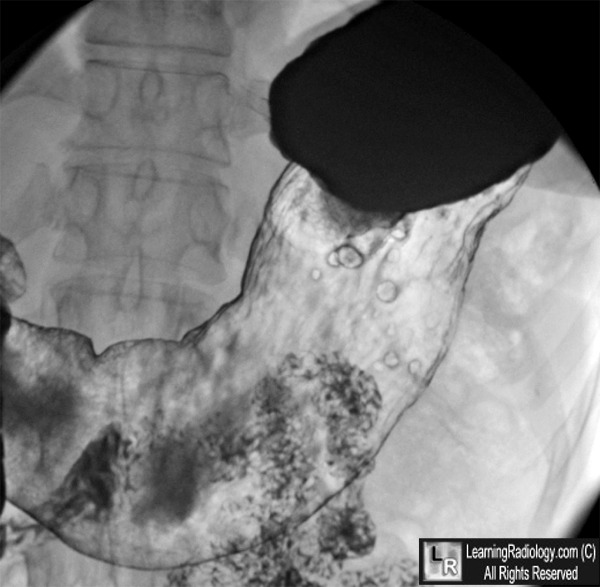
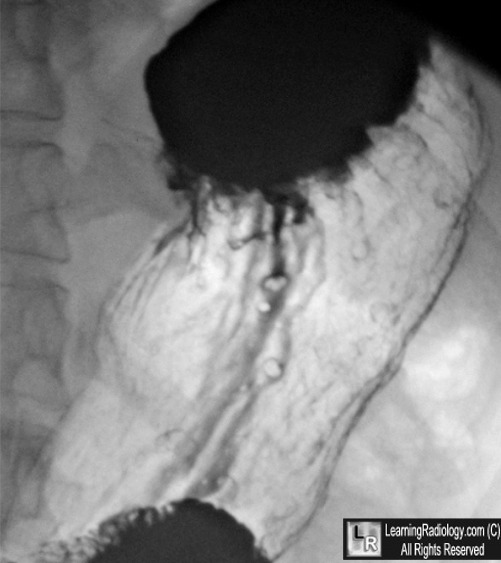
Hyperplastic gastric polyps. Upper photo. White arrows point to multiple filling defects on the anterior
and posterior walls of the stomach, some outlined by the barium pool, others etched in barium
representing numerous, small gastric polyps. Bottom photo: The same polyps are again shown (blue arrows).
For these same photos without the arrows, click here and here
For more information, click on the link if you see this icon 
|
|
|