|
|
Coin in the Esophagus
General Considerations
- More common in children ( < 5 years old) than adults
- Consist of either food-related impactions, or
- Ingestion of true foreign body (toy truck, marble, etc)
- True foreign bodies are more often ingested in those under 40 whereas those over 60 have food-related impactions
- Most often they impact just below cricopharyngeus at the thoracic inlet (70%)
- Another 20% impact at the level of the aortic arch
- Another 10% just above the esophagogastric junction
- Once past the esophagus, most foreign bodies will pass through the GI tract
- In children, most often ingested foreign body is a coin, followed by
- Chicken or fish bones
- Buttons and tacks
- Marbles or screws
- Button batteries
- Straight pins
- In adults, the most commonly impacted foreign body are food boluses (hot dogs, etc), followed by
- Fish bones
- Coins
- Fruit pits
- Straight pins
- Dentures
Clinical Findings
- Dysphagia
- Odynophagia
- Sensation of foreign body
- Even if foreign body passes, many complain of pain referable to cervical esophagus
- Only about half of those with impacted true foreign bodies have symptoms referable to the foreign body
- In children, symptoms more commonly include drooling, vomiting or gagging
Imaging Findings
-
Chicken bones are usually opaque
-
Fish bones contain less calcium and usually are not
-
Conventional radiographs will not demonstrate non-opaque foreign bodies
-
If impaction in the neck is suspected, then neck radiographs (soft tissue technique) are used first
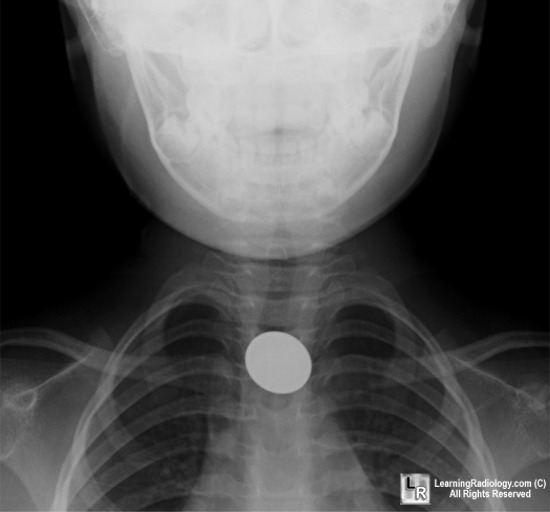
- Classically, coins in the esophagus project en face (round) in the frontal projection whereas
those in the trachea project on end in the frontal projection
-
Otherwise, a PA and lateral chest are obtained
- If neither of these studies reveal a foreign body known to have been ingested, then a supine
abdominal radiograph can be obtained
-
If negative, then either contrast esophagram or CT if high index of suspicion 
- In adults, rule out an underlying abnormality which narrows the esophagus such as a stricture or
carcinoma of the esophagus
Treatment
- Removal is most often performed using endoscopy
- Temporization and surgery are other options
- Glucagon is effective in up to 50% of patients in relieving the esophageal obstruction
- An ingested button battery lodged in esophagus must be removed immediately
- If impacted in esophagus, focal production of a small current may lead to esophageal perforation
- Button batteries should be removed endoscopically
- Once they pass into stomach, such batteries pose a lower risk
Complications
- Always check for lead lines in children (pica)
- Longer the FB remains impacted (>24hrs), higher incidence of perforation
- Perforation
- Stricture
- Diverticulum formation
Prognosis

Coin in esophagus. Close-up of a frontal view of the neck and upper chest shows a round metallic foreign body (white arrow) that lies in the midline just above the aortic knob (red arrow). This is a quarter that is impacted in the esophagus. Coins in the esophagus are round in appearance on the frontal view whereas coins in the trachea are usually seen on end and are linear in shape.
For this same photo without the annotations, click here
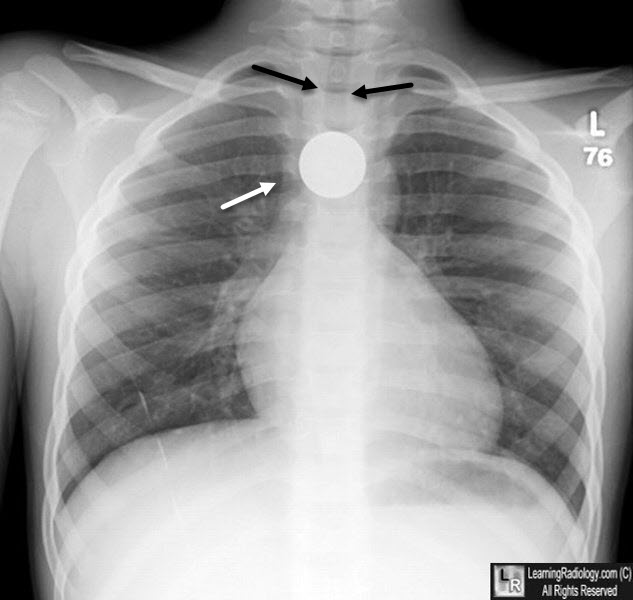
Coin in esophagus. There is a coin (a magnified US nickel) (white arrow) in the esophagus, impacted at the level of the aortic arch. The coin exceeds the diameter of the trachea (black arrows) so that it can not lie within the trachea. The coin passed by itself.
For more information, click on the link if you see this icon 
Ratcliff, K. Esophageal Foreign Bodies; American Family Physician, Sept, 1991
|
|
|

)