|
|
Miliary Tuberculosis
General Considerations
- Widespread hematogenous dissemination of Mycobacterium Tuberculosis
- So named because the nodules are the size of millet seeds (1-5mm with a mean of 2 mm)

- Miliary TB represents only 1-3% of all cases of TB
- Older men, African Americans and pregnant women are susceptible
- Considered to be a manifestation of primary TB–although clinical appearance of miliary TB may not occur for many years after initial infection
- When treated, clearing is frequently rapid
- Miliary TB seldom, if ever, produces calcification
- Under age 5, there is an increased risk of meningitis
Risk Factors
- Immunosuppression
- Cancer
- Transplantation
- HIV
- Malnutrition
- Diabetes
- Silicosis
- End-stage renal disease
Clinical Findings
- Onset is insidious
- Patients may not be acutely ill
- Symptoms include
- Weakness and fatigue
- Chills, night sweats are common
- Cough
- Hemoptysis
- Anorexia
- Hepatomegaly and lymphadenopathy are common
Imaging Findings
- Takes weeks between the time of dissemination and the radiographic appearance of disease
- Up to 30% have a normal chest radiograph
- When first visible, they measure about 1 mm in size; they can grow to 2-3mm if left untreated
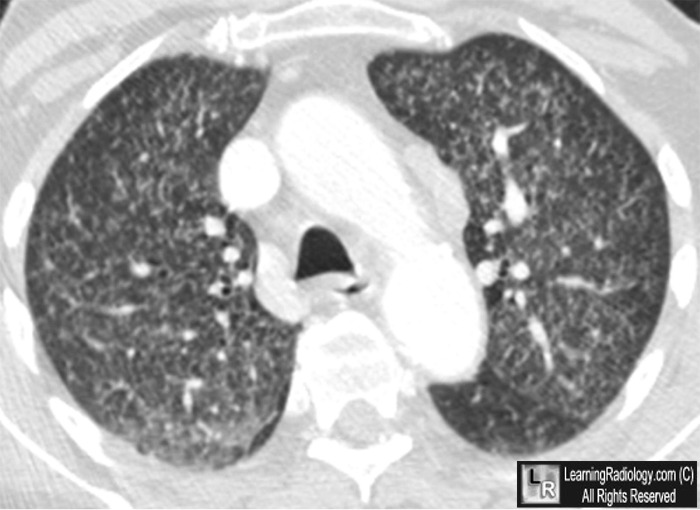
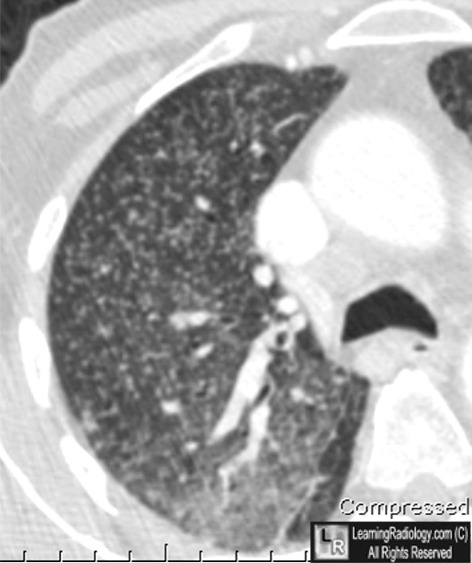
- Produces innumerable, non-calcified nodules
- High-resolution CT scans are more sensitive at demonstrating small nodules
- Nodules are either sharply or poorly defined
- 1–4-mm in size
- Diffuse, random distribution
- May be associated with intra- and interlobular septal thickening
Differential Diagnosis
- Pneumoconiosis, especially silicosis or anthrosilicosis
- Metastatic nodules, especially from thyroid carcinoma
- Sarcoidosis
Treatment
- Estimated that up to 50% of cases are undiagnosed antemortem
- Four-drug regimen to start
- Rifampin
- Pyrazinamide
- Ethambutol or streptomycin
- Treatment may continue for 6-9 months
- 9-12 months with meningeal involvement
Complications
- Dissemination via bloodstream to
- Liver
- Spleen
- Skeleton
- Kidneys
- Adrenals
- Prostate
- Seminal vesicles
- Epididymis
- Fallopian tubes
- Endometrium
- Meninges
Prognosis
- If not treated, almost 100% fatal
- With treatment, less than 10% mortality


Miliary Tuberculosis. Top. Innumerable, small, millet-seed sized nodules are seen distributed throughout both lungs, shown in close up view below (white circle).
For these same photos without the arrows, click here and here
For more information, click on the link if you see this icon 
Radiology. 1999;210:307-322. Pulmonary Tuberculosis: The Essentials Ann N. Leung, MD
|
|
|