|
|
Turner's Syndrome
- 1 out of every 2,000-2,500 female live births
- Almost all (95%) have
- Short stature
- Loss of ovarian function
- Caused by the absence of a set of genes from the short arm of one X chromosome
- Single X chromosome
- 75-80% single X is contributed by mother
- X-O = Female (Turner Syndrome)
- X-X-Y=Male (Klinefelter Syndrome)
- Hearing loss due to otosclerosis is common in adults
- Short stature
- Absent adolescent growth spurt
- Average adult height is 4 feet 8 inches
- Loss of SHOX gene necessary for growth of long bones
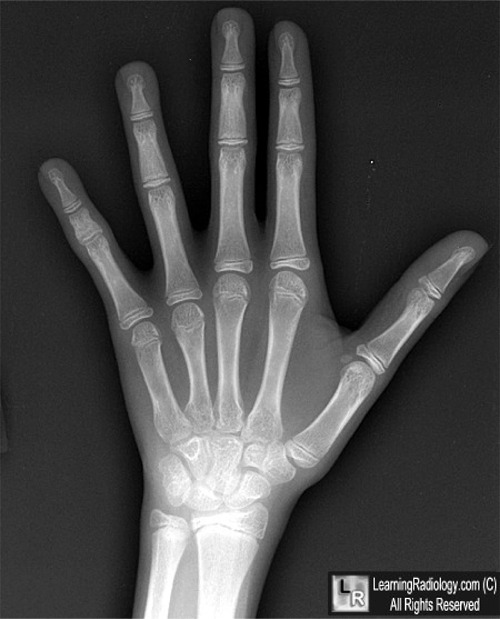
- Short fingers (4th metacarpal)

- Short toes
- Cubitus valgus – increased carrying angle (arms turn outward at elbow) the elbow
- Webbed neck
- Widely spaced nipples (shield crest)
- Excessive number of nevi
- Higher incidence of hip dislocation in infants
- Scoliosis in up to 10%
- Cutis laxa – loose folds of skin especially around neck
- Loss of ovarian function usually in early childhood
- Delayed puberty
- Estrogen therapy is frequently used to induce changes of puberty
- Coarctation of the aorta in 5-10%
- Bicuspid aortic valves in 15%
- Increased risk of aortic dissection
- Hypertension
- May be due to coarct or renal abnormalities or occur in absence of both
- High incidence due to inadequate circulating estrogen
- Type II (Insulin-resistant) diabetes
- Thyroid
- About 1/3 are hypothyroid, often with an enlarged thyroid

Short 4th metacarpal in Turner Syndrome. A line (white line) drawn across the
heads of the 4th and 5th metacarpals will normally not transect a portion of the head of the 3rd
metacarpal unless the 4th metacarpal is short (see list above).
For this same photo without the arrows, click here
For more information, click on the link if you see this icon 
SE Gibson and RA Prayson. Primary Pediatric Skull Lesions. Arch Pathol Lab Med: Vol 131, May 2007
|
|
|