|
|
Bladder Cancer
- Incidence
- In the US, bladder cancer is the 4th most common cancer in men
- Prostate
- Lung
- Colorectal cancer
- Bladder cancer
- It is the 10th most common cancer in women
- More common in whites than in blacks
- 3:1 male to female predominance
- Classic clinical presentation is painless, gross hematuria
- Risk factors
- Smoking
- Pelvic irradiation
- Exposure to aniline dyes
- Chemotherapy with cyclophosphamide
- Most common is urothelial carcinoma, formerly known as transitional cell carcinoma (90%)
- Squamous cell carcinoma (4%)
- Worst prognosis
- Associated with chronic infection and irritation
- Worldwide (not in the USA), squamous cell carcinoma of the bladder is the most common cell type
- In underdeveloped nations, associated with bladder infection by Schistosoma haematobium
- Adenocarcinoma (1%)
- Most common in bladder exstrophy
- Respond poorly to radiation therapy
- Stage of disease
- More than 70% of all newly diagnosed bladder cancers are superficial
- About 5% present with metastatic disease
- Most often lymph nodes
- Lung
- Liver
- Bone
- Central nervous system
- Prognosis
- Superficial bladder cancer has good prognosis with 5-year survival rates of 82-100%
- Prognosis for metastatic transitional cell cancer is much poorer with only 5% of patients living 2 years after diagnosis
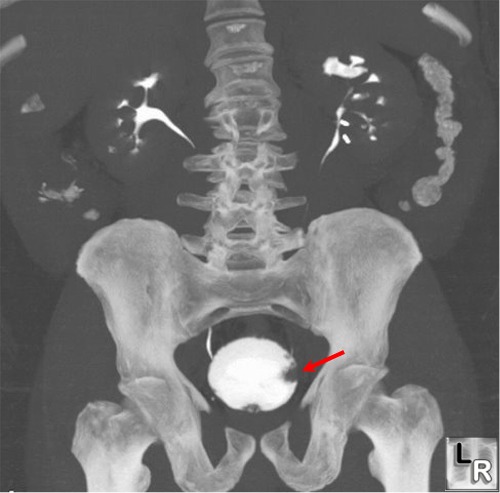
Bladder Carcinoma. CT
urogram. CT of the
abdomen with
contrast
reformatted in
the coronal
projection
shows a
filling defect
in the left
lateral wall
of the urinary
bladder (red
arrow)
representing a
papillary
urothelial
tumor of the
bladder.
eMedicine- Bladder Cancer - Gary David Steinberg, MD with Hyung L Kim, MD, Kush Sachdeva, MD, and Brendan Curti, MD
|
|
|
