|
|
Pulmonary Contusion
- Most common manifestation of blunt chest trauma
- Found especially in unrestrained drivers in motor vehicle collisions (deceleration injuries)
- Pathology
- Hemorrhage into the lung parenchyma produces airspace disease
- Almost always radiographically apparent within 6 hours after trauma
- May be clinically inapparent
- Hemoptysis is most frequent symptom (50%)
- Located posteriorly in lungs in most cases (60%)
- Usually at the site of direct impact
- But may occur on side opposite impact (contrecoup injury)
- May mask an underlying pulmonary laceration which may become more apparent after contusion clears
- Imaging findings
- Patchy or diffuse areas of airspace disease indistinguishable from any other cause of airspace disease except for the role of trauma and absence of air bronchograms
- Bronchi are filled with blood
- Hallmark is rapid resolution
- May be complete within 24-48 hours but more often takes about 3 days to clear
- Overlying rib fractures (frequent)
- CT findings
- Nonsegmental coarse ill-defined crescentic (50%) / amorphous (45%) opacification of lung parenchyma without cavitation
- "Subpleural sparing" outer 1-2 mm rim of uniformly non-opacified subpleural portion of lung
- Differential diagnosis
- If the consolidation lasts longer than 72 hours, consider
- Aspiration
- Pneumonia
- ARDS
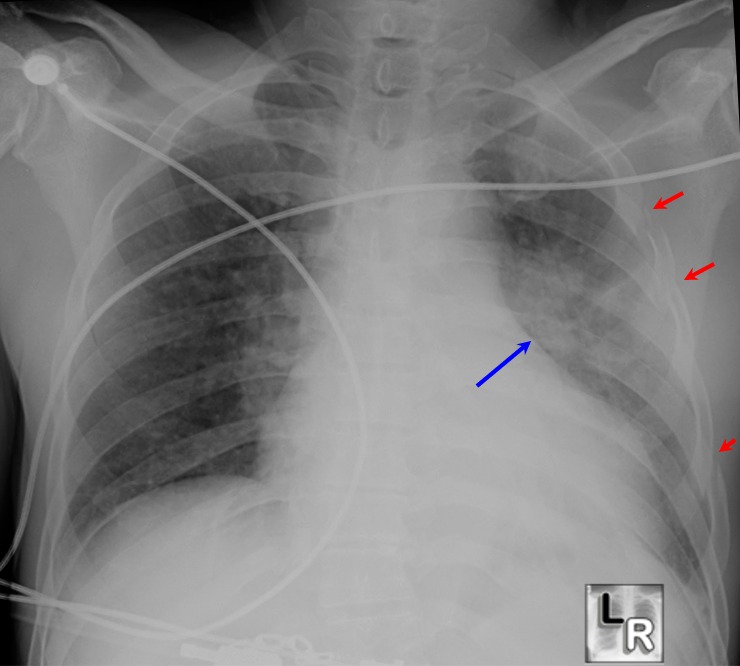
Pulmonary Contusion. Frontal chest
radiograph demonstrates
airspace disease in the
region of the
superior segment of the
left lower lobe (blue
arrow). The red arrows
point to multiple, acute
rib fractures.
The patient was an
unrestrained occupant in
a motor vehicle
collision and struck the
dashboard with his
chest.
The Requisites: Thoracic Radiology, Theresa McCloud, editor
|
|
|
