Pneumomediastinum
- Air in the mediastinal space
- Most common in infants
- Rare in adults
- Result of trauma
- Rupture of esophagus
- Rupture of airways
- Air in mediastinum originates from
- Lung
- Most common mechanism in neonates
and adults
- Begins with rupture of alveolus
- Usually from increased
intraparenchymal pressure
- Air dissects back along
perivascular sheaths to hilum and mediastinum
- Air from ruptured bleb can also
extend peripherally into pleural space
- Most instances can be related to
sudden rise in intrapulmonary pressure
- Asthma
- Vomiting
- Valsalva maneuver
- Artificial ventilation
- Closed chest trauma
- Sudden drop in atmospheric
pressure
-
Mediastinal
airways
-
Esophagus
§
Rupture of the esophagus – Boerhaave’s Syndrome
§
Can occur with
-
Vomiting
- Labor
- Severe asthmatic attacks
- Strenuous exercise (each of these
can produce pneumomediastinum without rupturing the
esophagus)
- Site of perforation
- Left, posterolateral wall,
distal 8 cm
- Imaging findings
- Combination of pneumomediastinum
and left pleural effusion is very suggestive
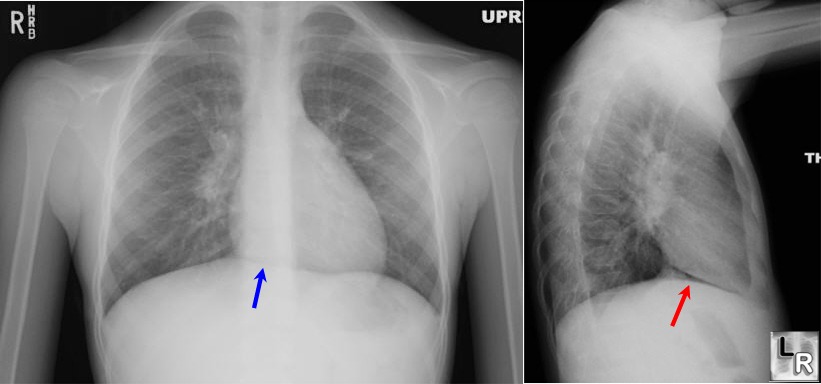
- “Continuous diaphragm sign” of
pneumomediastinum

Blue arrow points to
"continuous diaphragm sign." The entire diaphragm is visualized
from one side to the other
because air in the mediastinum outlines the central portion
which is usually obscured by the heart and mediastinal soft
tissue structures that are in contact with the diaphragm. The
red arrow points to the air beneath and posterior to the heart.
Click here for same photo without arrows.
- Symptoms
- Infants
- Adults
- Chest pain (retrosternal)
radiating down both arms aggravated by respiration and
swallowing
- Neck
- Trauma to the neck
- Air can track down onto mediastinum
- Imaging findings
- Linear density parallel to heart
border
- Separated from heart by air
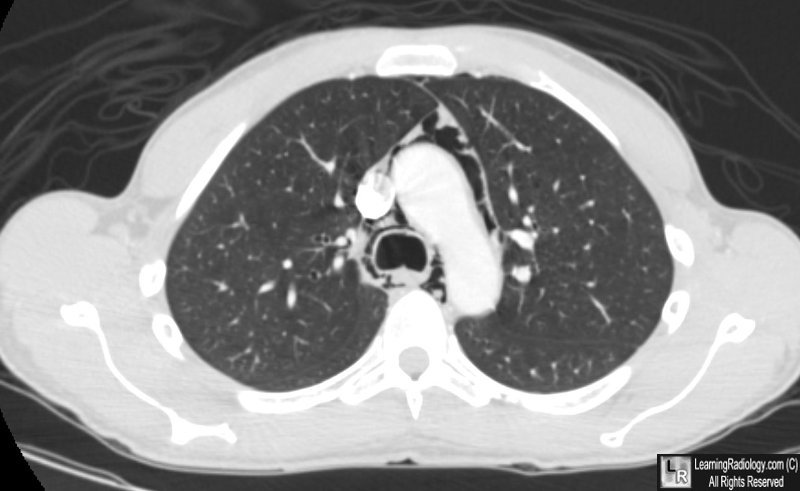
- Also ring lucency around aorta or
pulmonary artery
- “Ring around the artery” sign
- Dissection of air into neck is much
less common in infants than adults
- Dissection into chest wall much less
common in neonates than older
- Air can outline the central portion of
the diaphragm
- “Continuous diaphragm sign”
- Clinical Findings
- Abrupt onset of retrosternal pain
- Usually preceded by episode of
vomiting
- Pain is worse on inspiration
- Dyspnea could be severe
- Hamman’s sign – crunching sound
heard over the apex of the heart with cardiac cycle
Fraser
and Pare: Diseases of the Chest; W.B. Saunders, 1994.