|
|
Gas in Gallstones
- Approximately 20 million Americans have gallstones
- Gallstones are twice as common in women as in men
- Up to 55% of adult women were found to have gallstones at autopsy in some studies
- Gallstone prevalence increases with age
- In USA, 80% of gallstones are predominantly cholesterol and 20% are pigment stones
- Classification of gallstones
- Pure cholesterol stones
- Contain more than 90% cholesterol
- Mixed cholesterol stones
- Composed of > 50% cholesterol
- Usually smaller than pure cholesterol stones
- Often faceted and multiple
- Pigmented stones
- Unconjugated bilirubin carbonate and phosphate
- Unconjugated bilirubin monomers as well as cholesterol and calcium salts of fatty acids
- Brown pigment stones
- Commonly large
- Assumed to be caused by primary infection of bile
- Imaging Findings
- Plain films
- About 10-20% of gallstones sufficiently calcified to be visible on abdominal films
- Gallstones are usually round or oval in shape in right upper quadrant
- Multiple stones may show flattened sides called “faceted stones”
- "Mercedes Benz" sign is a triradiate collection of nitrogen gas
- Fills crevices created by shrinkage of cholesterol crystals in the stone
- Radiolucent fissures usually widest centrally radiating like points of star
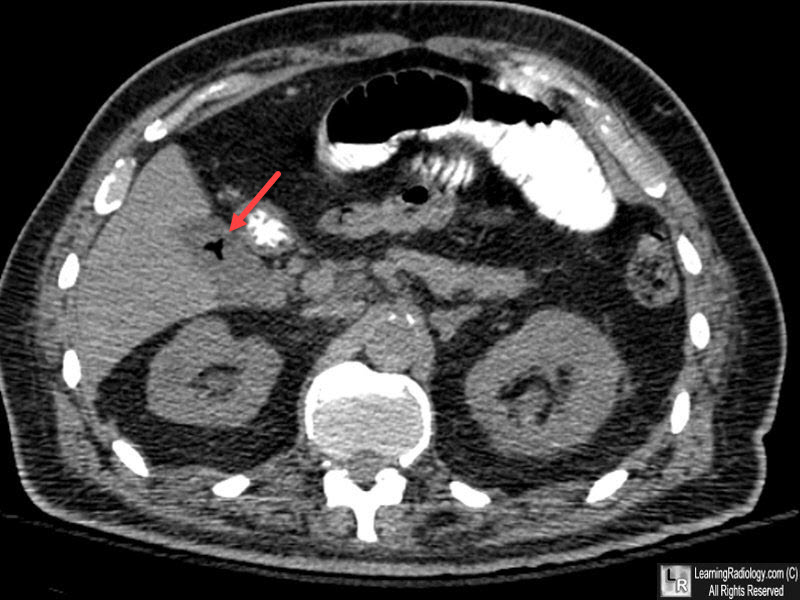
Mercedes Benz Sign. Red arrow points to tri-radiate spokes of air in gallstone.

Mercedes-Benz Hood Ornament
- Ultrasound
- The procedure of choice for gallstone diagnosis
- 95% accuracy of detection
- Moveable, discrete, echogenic foci within the dependent portion of the gallbladder
- Acoustical shadowing emanating directly below the echogenic foci
- Stones usually sink to dependent portions of gallbladder
- Cholesterol stones may float
- CT
- CT is superior to ultrasound for demonstration of calcification and of fissures in gallstones.
- Noncalcified stones may be difficult to detect
- CT is still more sensitive than plain film
- Noncalcified stones may be recognized as subtle areas of slightly lower or higher attenuation within the bile
- Well-calcified stones are shown easily on CT
- Stones that have attenuation equal to bile may remain invisible
- Cholesterol stones usually have an attenuation value that is lower than bile
- Visible on CT as hypo-attenuating structures
- Differential diagnosis
- Gross collections of gas that may occur in a subhepatic or liver abscess
- Emphysematous cholecystitis
- Gas in biliary ductal or portal venous system
- Gas in an abscess in right kidney
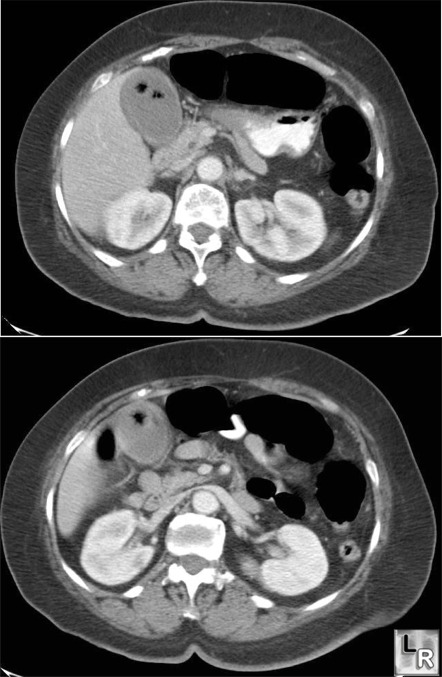
Gas in Gallstones. CT of the abdomen demonstrates two
radiolucencies in gallbladder (top image) and
an additional lucency in the gallbladder
on the lower image.
Amersham The Encyclopedia of Medical Imaging Volume IV:1
|
|
|
