|
|
Epiglottitis
- Acute
bacterial epiglottitis
- Life-threatening,
medical emergency due to infection with edema of epiglottis and aryepiglottic
folds
- Organism
- Introduction
of Haemophilus influenzae type B vaccine in 1985 has led to marked
decrease in number of cases of epiglottitis
- Still
remains the most common cause
- Also
caused by
- Pneumococcus
- Streptococcus
group A
- May
also be caused by thermal injury
- Age
- Typically
between 3-7 years
- Peak
incidence has become older over last decade and is now closer to 6-7 years
- Clinical
- Classical
triad is: drooling, dysphagia and distress (respiratory)
- Abrupt
onset of respiratory distress with inspiratory stridor
- Sore
throat
- Severe
dysphagia
- Older
child may have neck extended and appear to be sniffing due to air hunger
- Resembles
croup clinically, but think of epiglottitis if:
- Child
can not breathe unless sitting up
- “Croup”
appears to be worsening
- Child
can not swallow saliva and drools (80%)
- Cough
is unusual
- Location
- Purely
supraglottic lesion
- Associated
subglottic edema in 25%
- Associated
swelling of aryepiglottic folds causes stridor
- Imaging
findings
- Patient
needs to be accompanied everywhere by a physician experienced in
endotracheal intubation
- Imaging
studies are not always necessary for the diagnosis
- Lateral
radiograph should be taken in the erect position only, as
- Supine
position may close off airway
- Enlargement
of epiglottis
- Thickening
of aryepiglottic folds
- Circumferential
narrowing of subglottic portion of trachea during inspiration
- Ballooning
of hypopharynx and pyriform sinuses
- Reversal
of the normal lordotic curve of the cervical spine
- Fiberoptic-assisted, nasotracheal intubation is procedure of choice
- Complications
- Danger
of suffocation secondary to complete airway closure
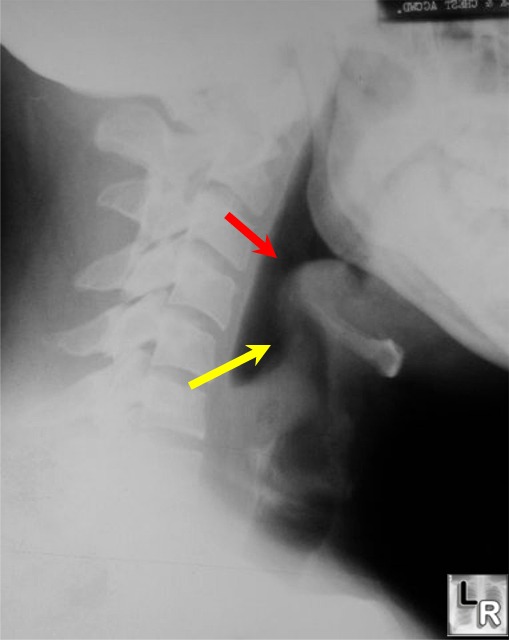
Epiglottitis. Lateral radiograph of the neck demonstrates and enlarged epiglottis (red
arrow) and thickening of the aryepiglottic folds (yellow arrow). There
is also reversal of the normal lordotic curve in the cervical spine and
slight dilatation of the hypopharynx.
|
|
|
