|
|
Lead Poisoning
Plumbism
- Pica
- Defined as persistent eating of non-nutritive material for 1 month or more
- Always search for lead lines in any child with an ingested foreign body
- Main source of lead intoxication is lead paint used in houses painted before 1980
- Absorption is greater in children than adults
- Lead may be inhaled as well as ingested
- Symptoms develop more quickly through GI tract
- Toxicity more severe with co-existing iron, zinc, or calcium deficiency
- Pathology
- Lead concentrates in metaphyses of growing bones
- Distal femur
- Both ends of tibia
- Distal radius leading to
- Failure of removal of calcified cartilaginous trabeculae in provisional zone
- Clinical findings
- Neurological
- Learning disability
- Decreased IQ
- Mental retardation
- Encephalopathy
- Motor deficits
- Seizures
- Cerebral edema
- Hearing loss
- Gastrointestinal
- Abdominal pain
- Nausea
- Vomiting
- Diarrhea
- Constipation
- Anorexia
- Metallic taste in mouth
- Ileus
- Renal
- Hematologic
- Affects blood synthesis
- Hemolysis
- RBC stippling
- Iron deficiency
- Musculoskeletal
- Soft tissue
- Blue-black line in gum margins
- Endocrine
- Decreased stature
- Decreased vitamin D levels
- Laboratory findings
- Imaging findings
- Cerebral edema in acute lead intoxication
- Particles of lead in GI tract
- Bands of increased density at metaphyses of tubular bones (growing bone)
- Metaphyses of growing bones may be dense normally
- Lead lines more apt to be seen in proximal fibula and distal ulna where growth is not as great as other long bones
- Lead lines may persist
- Bone-in-bone appearance
- Abnormalities in bone modeling
- Erlenmeyer flask appearance to distal femur
- DDx (see tables below)
- Treatment
- Surgical removal of lead foreign bodies in the gut (e.g. dice containing lead) if not eliminated within 2 weeks
- Chelation is indicated if the level is greater than 45 mcg/dL even if asymptomatic
- First correct iron deficiency
- Chelating agents include EDTA, BAL, D-Penicillamine, and Succimer
Lucent Metaphyseal Bands |
Normal |
Leukemia |
Neuroblastoma |
TORCH infection |
Dense Metaphyseal Bands |
Normal |
Lead poisoning |
Treated leukemia |
Healing rickets |
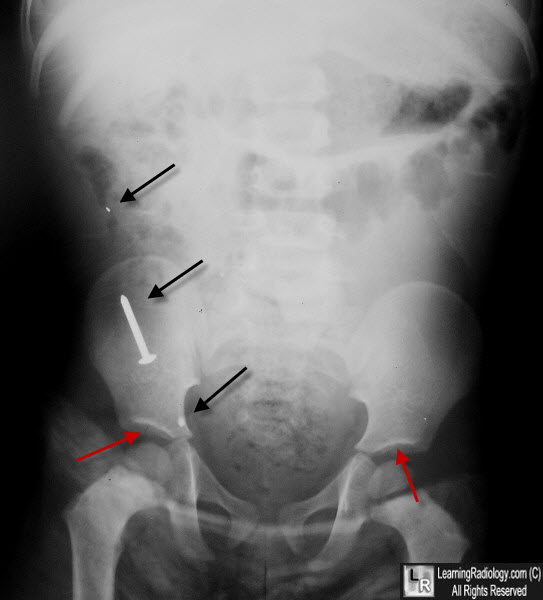
Lead Poisoning. There are multiple metallic foreign bodies in the bowel (black arrows) including a nail in the region of the cecum. This is pica. Anytime one sees evidence of pica, look for lead lines. In this case, there are dense metaphyseal lines forming the articular cortices of the acetabuli (red lines).
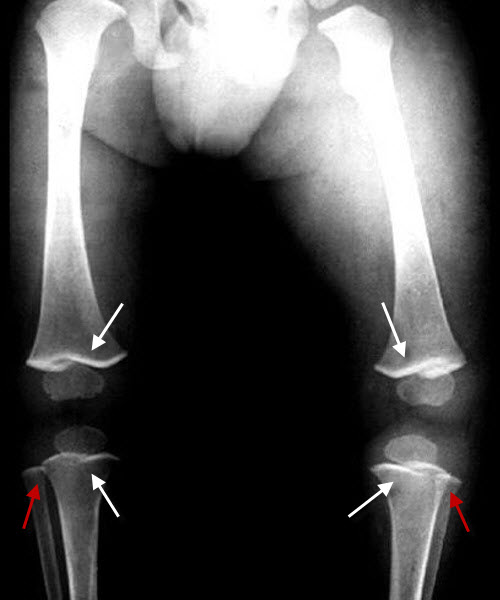
Lead Poisoning. There are dense metaphyseal bands at the distal femurs and proximal tibias (white arrows). Note also there are similar dense bands at the heads of both fibulas (red arrows).
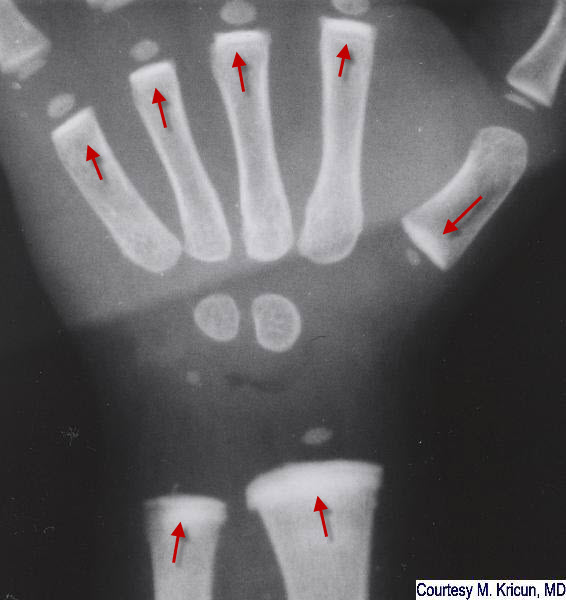
Lead Poisoning. There are dense metaphyseal bands at the distal radius and ulna and in all of the metacarpals (red arrows).
|
|
|
