|
Return to Case
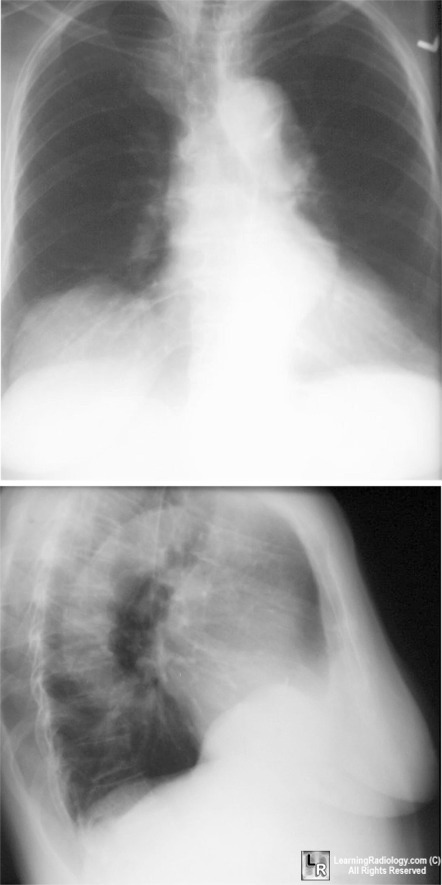
Eventration of the Diaphragm
Diseases of The Diaphragm
·
Eventration of the Diaphragm
o
Congenitally thin muscular portion of hemidiaphragm
o
Appearance,
however, still seems to increase with age
o
Anteromedial on right
§
R:L 5:1
- When on left, usually involves whole hemidiaphragm

Frontal and lateral chest x-ray shows smooth elevation
of right hemidiaphragm
medially and anteriorly consistent with an eventration of the hemidiaphragm
·
Anatomy of the Diaphragm
o
Muscle slips attach to 7-12th ribs
o
Innervated by phrenic nerve (C4, C3 and C5)
o
Central portion is tendinous; outer portion muscular
o
Right is 1/2 interspace higher than left in 90%
o
Mean diaphragmatic excursion = 0.8-8.0cm
·
Elevation of the Hemidiaphragm
o
Causes
§
Subpulmonic effusion
·
Dome is laterally displaced
·
Straight edge of
anterior “diaphragm” seen on lateral at major fissure
§
Decreased lung volume
·
Atelectasis
§
Hypoplastic lung
·
Small pulmonary artery, dextrocardia, scimitar vein
§
Poor inspiration
§
Phrenic Nerve Paralysis
·
BrCa
·
Mets
·
Iatrogenic-post CABG
§
Idiopathic
§
Abdominal Disease
§
Subphrenic abscess
·
Right=subhepatic-appendicitis
·
Left 2° ulcer perforation
§
Liver mass
§
Interposition of the colon
§
Distended stomach
§
Congenital Diaphragmatic Hernia
§
Traumatic Rupture of the Diaphragm
§
Eventration of the Diaphragm
·
Congenital Diaphragmatic Hernia
o
General
§
Absence of closure of pleuroperitoneal fold
§
9th gestational week
§
Male to female ratio of 2:1
§
1:2,000 live births
§
Left > right 9:1
o
Associated Anomalies
§
CNS–neural tube defects
§
GI–malrotation, omphalocoeles
§
CV
§
GU
§
IUGR
o
Bochdalek Hernia
§
90% of congenital hernias
§
Posterolateral defect
§
Abnormality of cephalic fold of
pleuroperitoneal membrane
§
Left (80%), right (15%), B/L (5%)
§
Babies–large
§
Adults–small
§
Organs Involved
·
Bowel
·
Spleen
·
Fat
·
Liver (left lobe)
·
Kidney, pancreas
·
Stomach
§
The “B’s”
·
Babies
·
Back
·
Big
o
Morgagni Hernia
§
Anteromedial parasternal defect (Space of Larrey)
§
Maldevelopment of septum transversum
§
Overweight, middle-aged, women
§
Right > left (heart protects)
§
Associated with
·
Pericardial defects
·
Omental fat in pericardial space
§
Organs Involved
·
Liver
·
Bowel
§
The “M’s”
·
Middle (anterior and central)
·
Mature (older children)
·
Miniscule
·
Congenital Absence of Diaphragm
o
Delayed onset of hernia may occur following streptococcal
infection
o
Imaging Findings
§
Initially, hemithorax may appear opaque because loops are
fluid-filled
§
Paucity of bowel loops beneath diaphragm
§
Once air swallowing begins, multiple lucencies contained
within bowel are seen in chest
·
Respiratory distress may increase as
intestine occupies more of thorax
§
Some loops may remain fluid-filled
§
Mediastinal shift to the opposite side
§
Relative paucity of gas in abdomen
§
If stomach remains in abdomen, it is more
centrally located than normal
o
Prognosis
§
Intrathoracic stomach
60%
§
Intra-abdominal stomach
6%
§
Polyhydramnios
89%
§
Operative mortality
40-50%
o
DDX
§
Cystic adenomatoid malformation
§
Staphylococcal pneumonia
§
Mediastinal cyst
·
Diaphragmatic Rupture
o
Blunt trauma (5–50%)
o
2° increased intra-abdominal pressure
§
MVA
§
Fall from height
o
Penetrating trauma (50%)
§
Knife, bullet
o
General
§
5% of all diaphragmatic hernias
§
Most (90%) are left-sided
§
Central and posterior >10cm in length
§
Contain stomach, colon, small bowel, omentum,
spleen
§
Half have no initial abnormal radiographic findings
§
Half are missed clinically
§
Associated with
·
Fx ribs
·
Pneumoperitoneum
·
Ruptured spleen
§
Delayed diagnosis = higher mortality
§
MRI most useful in showing site of tear
o
Imaging Findings
§
Air/fluid levels in left hemithorax
§
Contralateral shift of heart and mediastinal structures
§
Absence of bowel in abdomen
§
NGT in left hemithorax
§
“Pinch-cock” “hourglass” configuration of bowel through rent
in diaphragm
§
MRI shows diaphragm in all planes
o
Complications
§
Strangulation of bowel
§
Hydrothorax/hemothorax 2° strangulation
·
Hiatal Hernia
o
Most common form of diaphragmatic hernia in adult
o
Air/fluid level(s) in “mass” posterior to heart
o
May contain entire stomach
o
Can lead to volvulus
o
Usually projects to left of spine
·
Paralysis of the Hemidiaphragm
o
Most often from phrenic nerve involvement
§
Neoplasms, CABG surgery (2° ice)
§
Idiopathic
o
Males, right hemidiaphragm
o
Sniff test
- Paradoxical upward motion on affected side
§
Normal excursion of 1-2 ribs
·
Breathe in, diaphragm down
·
Breathe out, diaphragm up
§
Paralyzed – paradoxical motion
·
Breathe in, diaphragm up
·
Breath out, diaphragm down
§
Useless with large effusion
o
Paralysis of the hemidiaphragm versus eventration
§
Diaphragmatic motion is paradoxical in
paralysis but not with Eventration
·
Bilateral Paralysis of the Diaphragm
o
Less common than unilateral
o
Occurs in neurologic disease, syrinx, MS
o
Most develop respiratory failure and hypercapnea
·
Tumors of the Diaphragm
o
Very rare
o
Benign vs. malignant 50:50
o
Lipoma (most common benign)
o
Fibrosarcoma (most common malignant)
o
Mets occur via direct extension from pleura or lung
|