|
|
Total Anomalous Pulmonary Venous Return
TAPVR
Two
Types
Partial (PAPVR)
- Mild physiologic abnormality
- Usually asymptomatic
Total (TAPVR)
- Serious physiologic abnormalities
Partial
Anomalous Pulmonary Venous Drainage (PAPVR)
General
- One of the four pulmonary veins may drain into right atrium
- Mild or no physiologic consequence
- Associated with ASD
- Sinus venosus or ostium secundum types
Total Anomalous Pulmonary Venous Drainage (TAPVR)
- All have shunt through lungs to R side of heart
- All must also have R to L shunt for survival
- Obligatory ASD to return blood to the systemic side
- All are cyanotic
- Identical oxygenation in all four chambers
Types
- Supracardiac
- Cardiac
- Infracardiac
- Mixed
Supracardiac Type—Type I
- Most common (52%)
- Pulmonary veins drain into vertical vein (behind left pulmonary artery) to left brachiocephalic vein to SVC
DDx: VSD with large thymus
Supracardiac Type 1—X-ray Findings
- Snowman heart = dilated SVC+ left vertical vein
- Shunt vasculature 2° increased return to right heart
- Enlargement of right heart 2° volume overload
Cardiac Type—Type II
- Second most common: 30%
- Drains into coronary sinus or RA
- Coronary sinus more common
- Increased pulmonary vasculature
- Overload of RV leads to CHF after birth
- 20% of I’s and II’s survive to adulthood
- Remainder expire in first year
Infracardiac Type—Type III
- Percent of total: 12%
- Long pulmonary veins course down along esophagus
- Empty into IVC or portal vein (more common)
- Vein constricted by diaphragm as it passes through esophageal hiatus
- Severe CHF (90%) 2° obstruction to venous return
- Cyanotic 2° right to left shunt through ASD
- Associated with asplenia (80%), or polysplenia
- Prognosis = death within a few days
Mixed Type—Type IV
- Percent of total: 6%
- Mixtures of types I – III
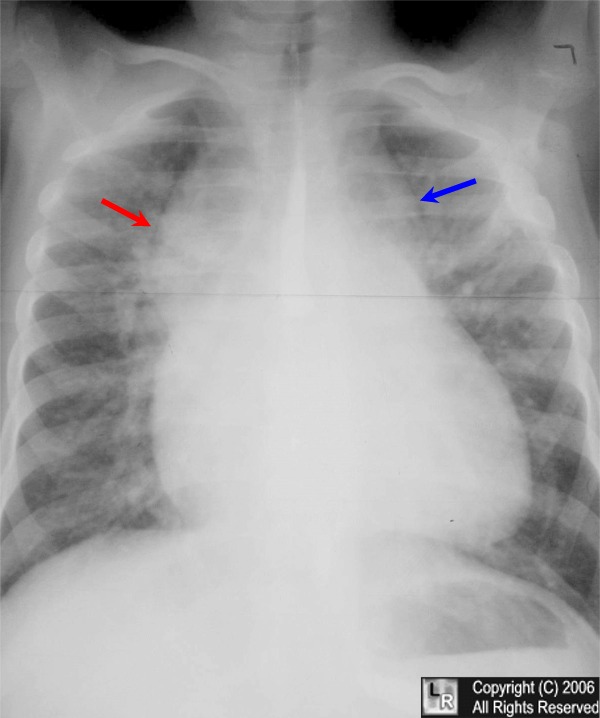
Supracardiac-Type I-TAPVR. The heart has a "snowman shape." The pulmonary veins drain into an enlarged
vertical vein (blue arrow) which in turn drains into the
brachiocephalic vein
and then to the superior vena cava (red arrow). The vasculature is shunt
vasculature.
For the same photo without the arrows, click here
|
|
|

